Watch my summary or read the full article below.
Personally, I blame Richard Branson.
Just because a neurodiverse entrepreneurial icon (in the best possible way) lived a life full of brash moves and louder PR stunts doesn't mean his tactics will work for you.
He famously said, "If someone offers you an amazing opportunity but you are not sure you can do it, say yes - then learn how to do it later".
It's way tradies come to my house and I end up catching them on YouTube trying to figure out a basic fix. More importantly, it's why so many of us believe we must be bigger, braver, and louder to get our message across.
We tell outselves to fake it until we make it. Shake off the anxiety and doubts, and just do it. (Yeah, Phil Knight - you've got a hand in this too.)
These embedded ideas of what good communication looks like aren't just outdated. They're harmful and actively hurting our impact.
The Myths Hurting Your Influence
Over the years, I've watched hundreds of professionals build and deliver presentations from the front of the room. The talks that linger, stick, and resonate are almost never polished, slick, or error-free.
Here are three dangerous myths to watch out for:
1. Confidence is King
I remember a quiet, softly spoken leader taking the stage to share his insights. He was slow, 'ummed' and 'ahrred' occasionally, and read straight from his notes with only a few glances at the room. Yet his thinking was invaluable, his language was simple, and his message was memorably authentic.
It was a masterpiece. Weirdly enough, he had deep inner confidence (as he had done the prep work), but the prototypical embodiment of 'confidence' was nowhere to be seen. Having inner confidence is excellent. However, projecting confidence has its limits.
Alternative Recommendation:
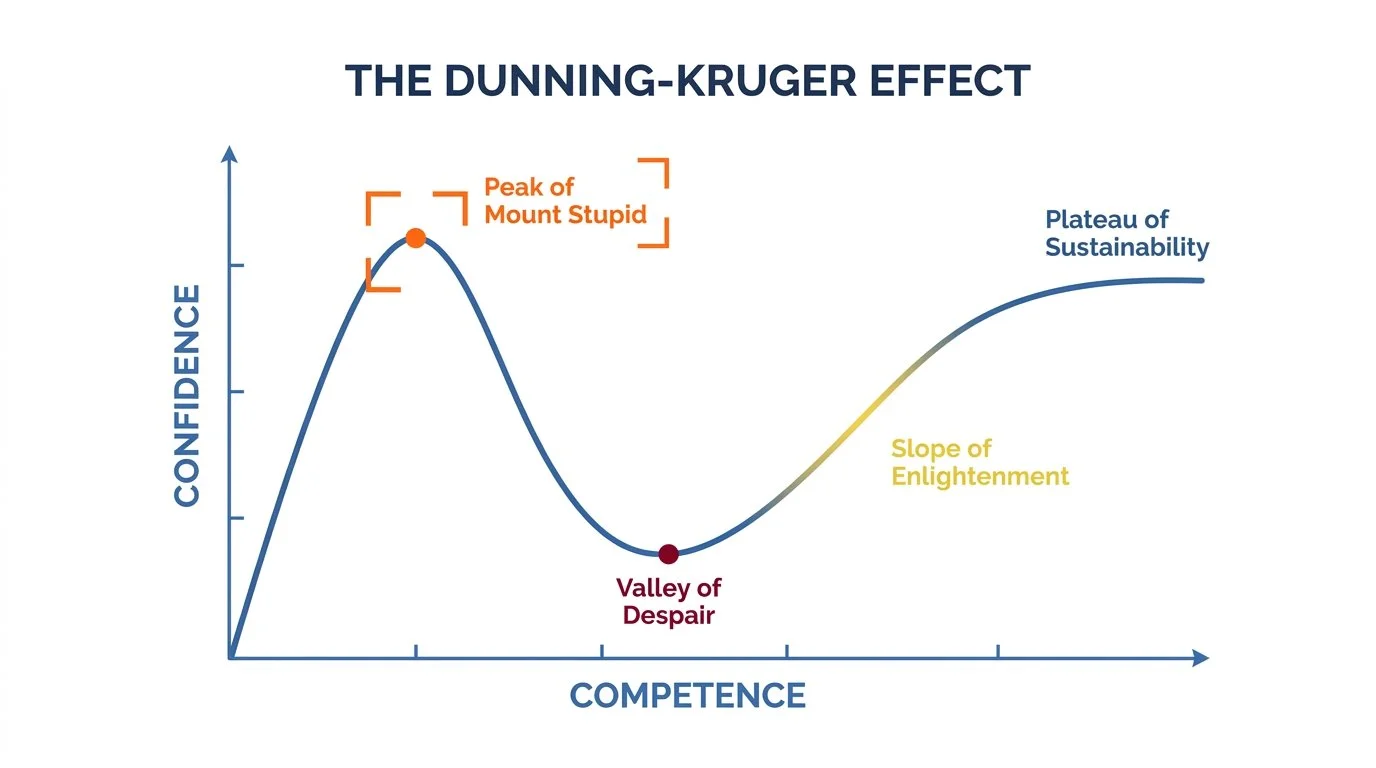
Don't land yourself on Mount Stupid (see image) by learning how to project confidence or 'faking it until you make it'. Instead, dig deep into the nuance, master your material, and explain it in the simplest possible language. The Dunning-Kruger Effect shows the incoherent relationship between confidence and competence - Peak Confidence is often Peak Incompetence. A worthy self reflection for all of us as communicators and listeners.
2. Charisma Is a Charm
People sometimes walk into my workshops with an air of "I've done all this before, it's easy for me". It's a dangerous attitude. They end up not doing the work. Relying on natural charm or bravado insead of preparation leads to flat delivery. They rarely stick the landing as well as they think they do.
We've all heard of power poses and dominant posturing, but none of them replicate the power of true charisma. The science on power posing is shaky at best (My Position on "Power Poses", Carney, Cuddy & Yap - 2010)
As Olivia Fox Cabane highlights in The Charisma Myth (2012), true charisma relies on a key ingredient most people miss: warmth. Charisma is relational, not postural! To be truly impactful it cannot be fabricated. It comes from within and it's felt between people. Influence flows through warmth.
Alternative Recommendation:
Instead of power-posing like the infamous 2017 Adelaide Crows at the AFL Grand Final, the best way to be 'more charismatic' is to invest in warmth first. Focus on being interested' rather than 'trying to be interesting'. Truly charismatic leaders are fully present, engaged, and undistracted - they lock in and make you feel like the only person in the room. Breed this into your thinking and their attention will begin to rise.

3. Communication Is Only For the Stage & Slides
It is astounding how little we use good communication technique when we talk with people all day long.
Clients often spend an entire coaching session dissecting a single high-stakes presentation, then stop there. When I ask, "What practice have you done since our last session?", the reply is often, "I haven't had a presentation to prepare".
As if clear communication only exists inside a PowerPoint deck. In reality, the exact same structures and frameworks apply tp everyday phone calls, quick check-ins, emails, and proposals.
Some people get this immediately and take every opportunity to hone their everyday comms. With this level of practice their influence and clarity skyrockets. Others, don't see the connection.
Alternative Recommendation:
Stop viewing communications tools as something to try on slides, see the structures and frameworks as a way of thinking. Treat them as a mental filter - a way to clean up your thoughts before they leave your mouth or hit the keyboard.
Faking it, relying on bravado, and restricting communication tools strictly for the stage presentations are three of the costly myths in modern leadership killing your influence.
In a noisy world, leaning into clarity, warmth, and daily practice will always beat shouting louder or puffing out your chest.
Buying into these myths to win attention doesn't build influence - it quietly blunts it.