On the weekend I went to an engagement party - which turned out to be a surprise wedding! It was nice in itself, but even nicer because of how rare it is to go to such an elegant and beautiful gathering (well, at least for us!)
Dressed up and ready to mingle, eat beautiful food, and dance, there was a cloud sitting over the experience: I had been asked to give a speech.
This turns a social occasion into a whole other beast.
Like anyone, I can get social anxiety, but speaking makes you part of the show and ramps up the stakes. I felt a few distinct hurdles in the lead-up to such a responsibility:
What am I going to say? There are hundreds of things I could say, yet I can't think of anything. Both thoughts occur at the exact same time.
What tone do I go for? Be funny (never going to happen). Be earnest (and keep a straight face?). Be someone else (if only I could). Be me (once again, if only I could!).
What are they going to think? An entire spectrum enters the mind - from weirdo, to incoherent wreck, to mumbling fool, to "the guy who ruined the whole thing". These visions dominate.
But then, there was a fourth hurdle.
I am a professional speaker.
This is the hurdle ruling them all. The expectations feel exponentially higher. In my mind, I need to be sharp, superb, natural, relaxed, and basically rockstar this thing. In their minds, I imagine they are thinking, "He does this for a living, so he'll smash it. There's nothing to worry about."
The thought of some of my best friends thinking like that makes it all so much worse. The stakes just multiplied exponentially.
The Pro Kicked In
It's only human to have these sorts of thoughts - I'm sure I'm not alone. But in preparation for the big night, I got to work...
Step 1: A Long Run-Up
Any form of spoken communication is the result of everything people don't see. When we go to a concert or a show, we are witnessing roughly 2-5% of the work. The sheer volume of unseen rehearsal and practice adds up to hundreds of hours.
For this speech I started thinking about it weeks ahead. Personally, I find the shower, driving, and hitting golf balls to be the best places for dreaming up stories, themes, and ways to attack the speech.
I also find talking helps. A few texts and emails here, a few chats and calls there. Listening to others talk about the themes you want to cover helps crystallise ideas and imagine what "good" looks like.
Step 2: The Three-Drafts Rule
The first draft of anything is rubbish. But it is necessary, and the ripple of that first draft will be felt and heard in the final delivery. I wrote out my first draft and left it on my desk for a week.
Then came the second draft - keeping the bits I liked, adding others, and deleting a whole lot. The important thing at this stage? It was shorter than the first draft. Clarity and confidence were building.
Finally, on the day of the event, the very last thing I did before getting ready was write the final draft. It had three key points with the words 'Slow' and 'Enjoy' written across the top.
This draft was written on a note the size of my palm.
Step 3: The Practice
As these drafts were coming together, I was practicing the main elements almost every day: while getting dressed, cooking dinner, exercising at the gym, and once again, in the shower. (That bathroom renovation really should have been a tax write-off!)
Even though the speech evolved over time, I was saying the key passages out loud constantly. When it came to 'the moment,' this habit was easily the most important.
The Realisation
Earlier in the year, I did my first professional MC gig. In preparation, I got on a call with Adam Thornley to pick up a few tips. Adam hosted the Club Legends Charity Event I organised back in 2021, and he's a DJ, Gold Coast Suns ground announcer, and seasoned MC.
He drummed two key principles into me about holding the mic in these situations:
Gateway 1 - Connection. You are there to connect people with the moment and the cause. In this case, it was to celebrate two amazing people coming together. Take your time to look up, look people in the eye, give a warm smile, and be 100% present with them. Not for them, not for you - with them.
Gateway 2 - Privilege. Not in the upper-class or fancy-school way, but rather in recognising what an honour it is to be invited into the proceedings.
In the past, I've experienced regret once events are over, understanding that the gathering was a one-off, realising I had let anxiety or fear stop me from being fully present or saying everything I wanted to say. It has taken decades, but I'm starting to understand how rare these opportunities are.
Every time you get to talk, witness, gather, or present, it is a true privilege. To be given that responsibility is an honour to cherish - these moments don't come around nearly as often as we think.
The Realisation
The twist of a surprise wedding is that the speech was written for an engagement party. The good news? In the end, it doesn't matter (when you think about it, not much needs changing!).
The intimidating part was that the wedding vows and speeches before me were top-class - they were going to be impossible to top. The comforting realisation? I didn't have to top them! It's not a bloody competition.
When I was called to the mic, I had a weird moment. I had a glass of water in one hand and the mic in the other, so I didn't pull my palm-sized speech out of my pocket. In an instant, my brain said, "Feck it, just go with the flow."
And I did.
Autopilot kicked in, and whatever happened from that point on just needed to happen. I missed a few things, I added a few things, I got a little choked up in the middle, and I had a moment or two of questionable mic technique. But overall, I survived to tell the tale.
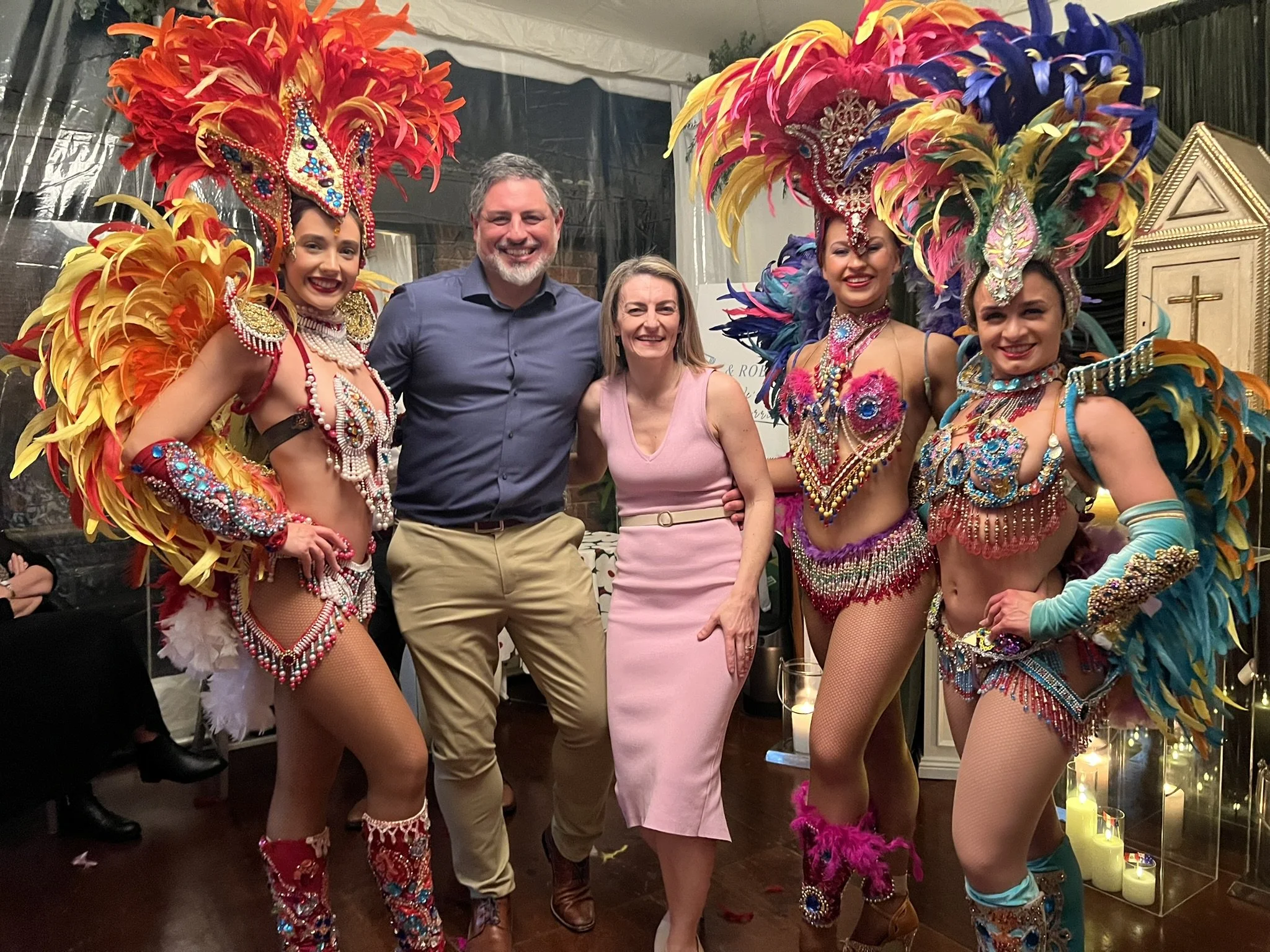
And what a fun wedding it was! What a privilege to not only witness such a beautiful moment, but to be a part of it. Jana and I with the amazing South American dancers - what a show!
The Reality
Looking back, there were four speeches besides the beautiful couple.
Two were read by the groom's niece. The mother and sister had put together some beautiful words but couldn't get up and deliver them themselves. The niece read them out word-for-word, and it was exquisite.
Reality One: If you need to read your speech word-for-word, that is completely okay. If the intention and content are spot on, the delivery method matters far less than we think
Then it was my turn. I was suffering from every level of anxiety described earlier. The expectation felt crippling. My sense of inferiority was overwhelming. The internal struggle was in overdrive. But the autopilot was well-trained. It wasn't perfect, but I got my point across. I didn't embarrass myself or ruin the occasion (pass mark #1). I didn't steal the show, nor should I have. I didn't offend anyone, and I did okay. A few people were generous enough to compliment me afterwards - always a good sign.
Reality Two: Doing a 'good job' has a lower pass mark than we think. Be solid, be reliable, take the responsibility seriously, and do your best. That is more than enough.
Finally, I passed the mic to the last speechee (if that's a word). She was reading from her phone, and halfway through, her finger grazed the screen and the phone flicked off. I watched over her shoulder as she desperately tried to find her note and her place. She apologised to the audience. She got frazzled. She apologised again. Then she found her spot and delivered the rest.
And guess what? No one cared! She had most of the room in tears. Mascara was running all around the room. My speech was a bit more polished in its delivery, but she hit their hearts. And that is what mattered.
Reality Three: Perfect truly is the enemy. The stuff-ups make you human. The blips make you more relatable. Authentic words and genuine intention speak louder than any speaking technique. It is one of the most beautiful parts of being human.
The Last Word
The philosopher Bertrand Russell believed self-doubt is the mark of wisdom - that those speaking with absolute confidence are often masking an ignorance of nuance.
Jonny Thompson summarised this better than I ever could here.
If you find yourself speaking at a meeting, presenting at a conference, or giving a toast at a milestone event like a wedding, do yourself a favour and remember:
Upfront effort pays off: Take a long run-up at it.
It's a privilege to have the mic: Be the connector and enjoy the honour.
You will survive: Let go and let your autopilot take the wheel.
Authenticity eats technique for breakfast.
Drop the illusion: Don't focus on being polished, influential, or "the best."
It is far more helpful to focus on the honour of these moments (even the small ones, like team meetings or Teams calls) and to be authentic, warts and all.
When we understand self-doubt can be an asset and overconfidence a hindrance, the whole game changes - and a world of opportunity opens up for all of us.